
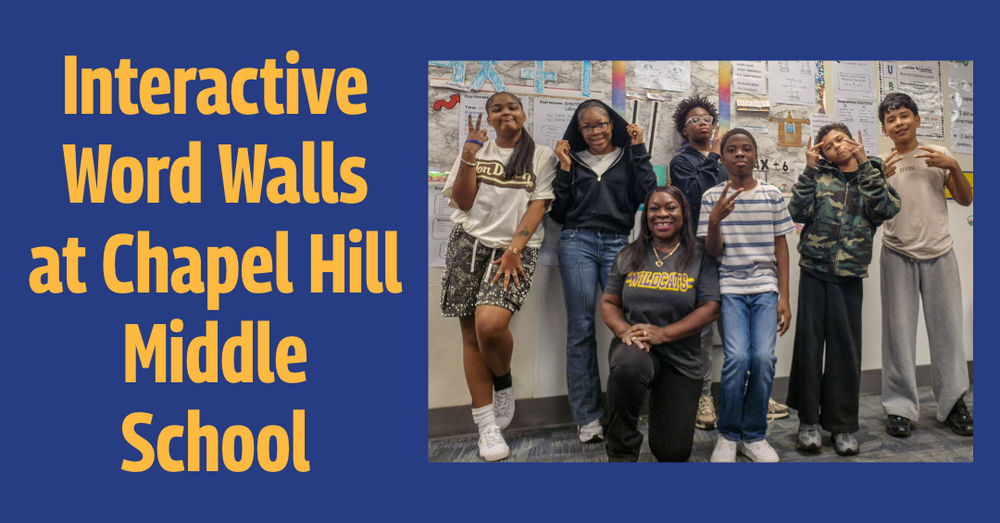
Students in Janet Joiner-Demby’s seventh-grade math classroom at Chapel Hill Middle School are learning the number system, expressions and equations, and ratios and proportional relationships with Interactive Word Walls she built for each unit.
The walls are designed for students who need the most support.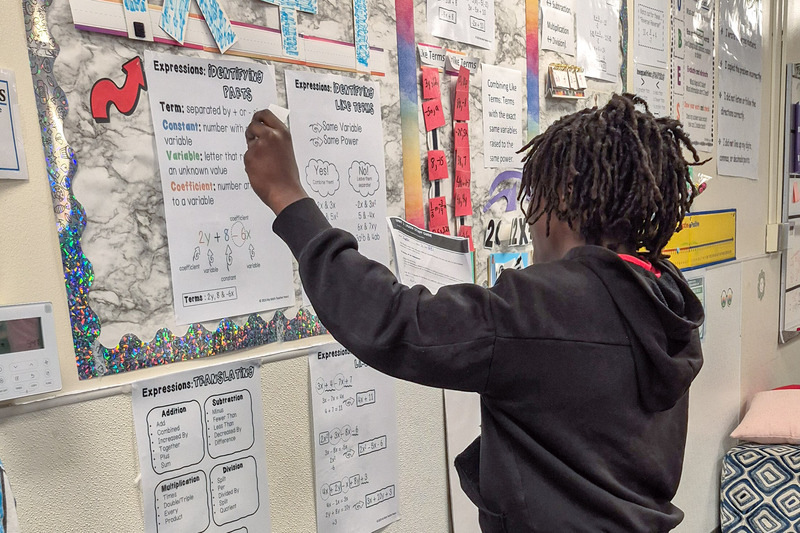
“These word walls serve as intentional visual and tactile scaffolding, specifically designed to engage and support students who are performing two or more grade levels below expectations,” Joiner-Demby said.
The idea started with a question: How can we better engage students with the material?
She wanted a vertical surface that would get students up and moving. A physical component, she said, would also boost retention.
Students have noticed the difference, noting the wall makes math “feel more tangible and real.” It also allows them to connect what they do with the wall to the assignments they complete at their desks.
“My goal is always to make math an experience rather than a task,” she said. “It takes mathematical vocabulary off the page and puts it directly in the students’ hands.”
Alongside the walls, Joiner-Demby has developed a set of replicable instructional guides to help other educators create similar interactive spaces or use them as springboard ideas for their own classrooms.